Community Events vs Backyard Parties: Rental Needs Compared
Picture this: a child's backyard birthday with a bounce house, cake table, and a dozen friends running around. Now picture a neighborhood fall festival with multiple activity stations, families coming and going, and volunteers managing different zones. Both might include a bounce house, tables, and games, but the planning considerations can be very different.
The right rentals depend on attendance, activity flow, venue requirements, available space, and who will be responsible for managing the event. This guide will help you identify the equipment and planning requirements that matter most to your event, whether you're hosting an intimate backyard celebration or coordinating a larger community gathering in the Sacramento area.
What's Covered in This Guide
- How People Use the Space Differently
- Rental Needs at a Glance
- What Works for a Backyard Birthday
- What Changes for Community Events
- Choosing Inflatables by Event Size and Age
- Space, Power, and Setup Confirmation
- Two Realistic Sacramento Event Plans
- How to Avoid Renting Too Much or Too Little
- Frequently Asked Questions
The Biggest Difference Is How People Use the Space
A backyard party typically has guests who arrive within a relatively short period, know the host, and share a limited number of activities. The flow is predictable. Children take turns on the bounce house, adults gather near the food table, and everyone knows where things are.
A community event may have families arriving at different times, moving between activity stations, and including different ages, interests, and schedules. Some guests might stay for the entire event, while others stop by for 20 minutes. This creates different demands on equipment, seating, and supervision.
The key insight: Your event layout should reflect how guests will move and participate, not simply how many attractions will fit in the available space. Equipment placement, participation patterns, queue areas, seating zones, and supervision all change based on the event format.
Backyard Parties vs Community Events: Rental Needs at a Glance
Here's how the two event formats typically differ in planning and rental requirements:
| Planning Factor | Backyard Party | Community Event |
|---|---|---|
| Guest Attendance | Usually a more defined invitation list | May be larger, fluctuating, or open to the public |
| Entertainment | Often one main activity with optional additions | May benefit from multiple activity zones |
| Inflatables | Selected around guest ages, space, and capacity | Selected around ages, capacity, queues, and participation flow |
| Tables and Chairs | Primarily for food, seating, and gifts | May support dining, check-in, volunteers, and activity stations |
| Venue Access | Residential gates, driveways, and yard access | Facility entrances, parking, delivery routes, and restricted areas |
| Power | May rely on available approved power access | May involve multiple equipment locations and power-planning needs |
| Supervision | Adults assigned to monitor equipment use | Designated monitors and clearer responsibilities across stations |
| Permissions | Property-owner approval and site restrictions | Venue, organizer, and possibly local authority requirements |
| Scheduling | Often a relatively contained party timeline | May need coordinated delivery, event hours, and equipment removal |
These are common differences, not universal rules. A small backyard gathering might need careful power planning if the equipment is far from an outlet, and a well-organized community event might have simpler logistics than expected. The point is to think through how your specific event will operate rather than assuming all events of the same size work the same way.
What Rentals Make Sense for a Backyard Birthday?
Backyard birthdays benefit from simplicity. You don't need to fill every square foot of your yard with equipment. Focus on what will create a memorable experience without overwhelming your space or budget.
Start With the Main Activity
For many smaller gatherings with a manageable guest list, one correctly sized and age-appropriate bounce house can be sufficient. Children typically take turns, and downtime between bouncing sessions gives them a chance to eat, play other games, or open presents.
If your space and budget allow, bounce and slide combos add variety without requiring a second setup area. Just confirm the footprint fits comfortably in your yard with proper clearances. Don't assume one inflatable can accommodate all guests at the same time. Plan around realistic participation patterns.
Add Seating and Food Equipment Based on the Actual Plan
Think about where adults will sit, where you'll serve food, and whether you need a separate gift table. Tables, chairs, and tent rentals can make your backyard more functional, especially if your patio furniture won't accommodate everyone comfortably.
Avoid adding concession equipment or extra games just because they're available. Stick to what matches your party's food plan and timeline.
Check the Setup Space Before Booking
Measure your gate width, delivery route, setup location, and distance to the nearest power outlet. Confirm the ground is level and suitable. Every inflatable has specific clearance and setup requirements, so don't assume it will fit just because your yard looks big enough.
Real Example: A family in Elk Grove expects around 20 total guests for their child's birthday, with about 8 children participating in the main activity. They prioritize one age-appropriate bounce house, seating for adults, a table for cake and snacks, and confirm setup access and power before booking. This approach keeps the event manageable without unnecessary equipment.
The takeaway: Choose rentals around your party's actual needs rather than trying to fill every available space. A focused, well-planned backyard birthday can be just as memorable as a larger event.
What Changes When You're Planning a Community Event?
Community events introduce additional complexity because you're managing more moving parts: varied arrival times, different age groups, activity stations, volunteers, and venue-specific requirements.
Plan for Participation and Lines
Estimate your expected peak attendance, not just total attendance. If you're hosting a 3-hour event and 150 people might stop by, how many will be there at the same time? What age groups will participate, and how many might want to use an attraction simultaneously?
Throughput matters. Throughput is the rate at which guests can enjoy an activity without excessive wait times. Some inflatables naturally process participants faster than others, but this depends on the specific unit and its operating procedures. Plan around realistic participation flow.
Build Different Activity Areas When Appropriate
A mix of games and inflatables can sometimes distribute guests more effectively than concentrating everyone at one attraction. Options might include inflatable obstacle course rentals, carnival game rentals, or interactive sports games.
Choose equipment only when it suits your space, budget, and event goals. More rentals don't automatically mean a better event. What matters is whether each activity serves a specific purpose and fits your operational plan.
Assign Clear Responsibilities
Community events need designated people handling specific tasks: a rental contact, volunteers or attendants at each activity station, venue coordination, and equipment supervision. Rental delivery staff typically handle setup and pickup, but they don't automatically stay onsite as event attendants.
Make sure everyone involved understands their role before event day. For school and PTO events, consider reviewing our guide on coordinating rentals for school and PTO events.
Confirm Venue Requirements Early
Different venues have different rules. Public parks may require permits. School properties might need insurance documentation. Church facilities may restrict access routes or setup times. Confirm these requirements with the property owner and applicable local authority well before your event date.
Also verify power availability across all planned equipment locations, delivery and access routes, and any event-site restrictions that could affect your rental choices.
The takeaway: Larger events need coordinated use of equipment and space, not simply more rentals. Focus on operational flow, clear responsibilities, and venue-specific planning.
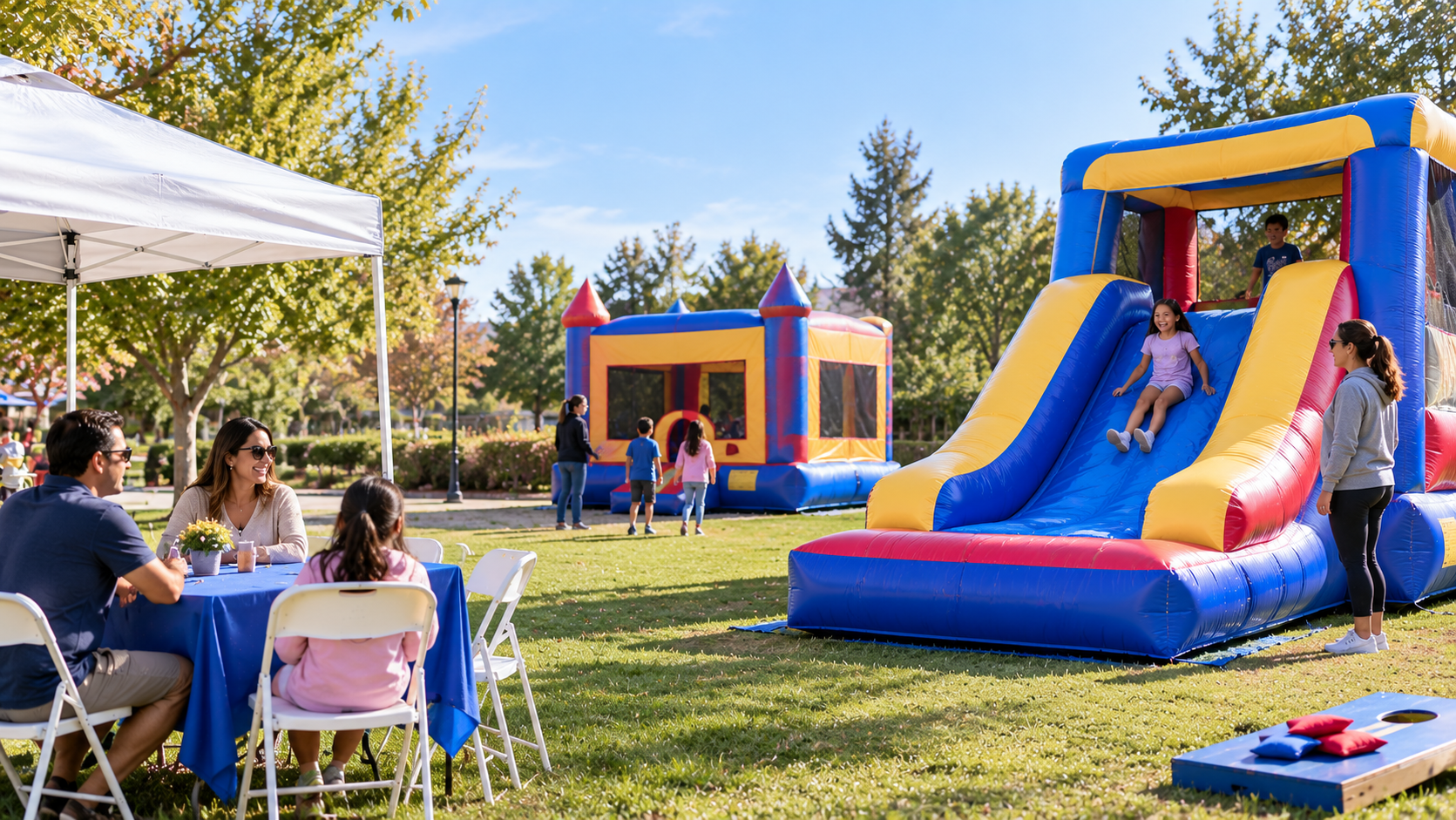
Choosing Inflatables for Different Event Sizes and Age Groups
Product selection should consider your audience, not just the total number of guests. Here's a quick comparison of rental categories and what to confirm before booking:
| Rental Category | May Suit | What to Confirm |
|---|---|---|
| Bounce Houses | Children's birthdays and designated play areas | Age suitability, capacity, dimensions |
| Bounce and Slide Combos | Events seeking more than one type of activity | Footprint, age guidance, participant flow |
| Obstacle Courses | Organized group activities and some larger gatherings | Space, size restrictions, supervision, throughput |
| Carnival Games | Mixed-age gatherings and activity stations | Placement, staffing, game suitability |
| Interactive Sports Games | Groups seeking a different form of participation | Age and size restrictions, equipment requirements |
Avoid making universal assumptions about which inflatable works best for crowds. Performance depends on the specific unit, its operating procedures, and how well it matches your event's supervision and flow plan.
Space, Power, and Setup: What Both Events Need to Confirm
Whether you're hosting a backyard birthday or a community event, certain setup requirements apply to every rental. Here's what to confirm before booking:
- Exact setup location with sufficient clearances
- Surface type and level ground
- Manufacturer-required clearances for safe operation
- Delivery and access routes for equipment transport
- Suitable power access and any approved generator requirements
- Other venue restrictions (noise ordinances, time limits, setup zones)
- Weather and contingency planning for outdoor events
- Responsible adult supervision at all times during equipment use
Community events may require these details across several equipment stations, while backyard parties may involve fewer locations. Either way, confirming setup requirements before booking prevents day-of surprises. For more detailed guidance, review our article on planning power access and setup zones.
Compare Two Realistic Sacramento Event Plans
Here's how the planning guidance translates into two real-world scenarios in the Sacramento area:
Example 1: A Backyard Birthday in Elk Grove
Scenario: A family expects approximately 20 total guests, with 8 children participating in the main activity.
Possible Planning Priorities:
- An age-appropriate bounce house that fits the backyard space
- Seating for adult guests (tables and chairs if patio furniture won't suffice)
- A suitable table for food and cake service
- Confirmed setup access through the side gate and verified power outlet location
- A simple adult supervision plan (one designated adult watching the bounce house)
The exact product depends on the children's ages, the bounce house capacity, available yard dimensions, and other specific requirements. The family avoids overbuying by focusing on what creates a memorable celebration without unnecessary equipment.
Example 2: A Community Fall Gathering in Citrus Heights
Scenario: A neighborhood group expects approximately 150 people to visit a 3-hour event.
Possible Planning Priorities:
- Expected peak attendance (likely 60-80 people at one time, not all 150 simultaneously)
- Multiple suitable activities if the site and budget support them (mix of inflatables and carnival games)
- Clear activity zones with defined walkways between stations
- Seating or tables for registration, food service, and volunteer coordination
- Designated organizers and equipment monitors at each activity station
- Venue approvals from the park district, confirmed access routes, and power planning for multiple zones
Importantly, 150 total visitors does not mean 150 simultaneous inflatable users. The organizers focus on peak demand and realistic participation flow, choosing equipment that matches how the event will actually operate.
Key Conclusion: Neither event automatically needs a long rental list. Each needs an appropriate plan that reflects the actual guest flow, venue constraints, and supervision capacity.
How to Avoid Renting Too Much or Too Little
Here's a practical decision sequence you can follow for any event:
1
Define the Event's Main Goal
What kind of experience do you want to create? A focused birthday celebration or a multi-station community gathering?
2
Estimate Peak Attendance and Ages
How many people will be there at the busiest time? What age groups will participate?
3
Confirm Space and Venue Requirements
Measure your setup area, check access routes, verify power, and confirm any venue-specific rules.
4
Choose Main Activity or Stations
Select inflatables and games that match your event format, not just the guest count.
5
Add Supporting Equipment Where Necessary
Include tables, chairs, tents, or concessions only when they serve a clear purpose in your event plan.
6
Verify Capacity, Power, Access, Supervision
Double-check that every rental fits your space, meets your power requirements, and has a supervision plan.
This approach reduces unnecessary rentals while also identifying gaps before event day. Price matters, but fit and function matter more. The right rentals support your event's goals without creating operational headaches.
The Right Rentals Make Either Type of Event Easier
A backyard birthday and a large community gathering can both be successful with the appropriate equipment. Small events often benefit from simplicity and focused planning. Larger events often require more structured coordination and activity flow management. Neither approach is automatically better.
Sacramento Party Jumps provides inflatable entertainment and supporting party rental equipment for events across the Sacramento area, with professional delivery and setup. Whether you're planning a backyard celebration or a community gathering, the goal is the same: choose rentals that match how your event will actually operate.
Ready to explore options for your event? Browse available categories or reach out to discuss your specific needs.
Plan Your Sacramento Event With Confidence
Whether you're organizing a backyard birthday or a community celebration, we'll help you find rentals that fit your space, guests, and goals. No pressure, no pitch—just helpful guidance.
Book Online NowFrequently Asked Questions
What is the biggest difference between backyard party rentals and community event rentals? +
The main difference is how guests use the space and equipment. Backyard parties typically have a defined guest list, one main activity, and simpler coordination. Community events often involve larger or fluctuating attendance, multiple activity zones, designated volunteers, venue permissions, and more structured equipment supervision and guest flow.
Is one bounce house enough for a backyard birthday party? +
It depends on the ages of participants, how many children will be playing at the same time, the specific inflatable's capacity, and how the party is organized. For many smaller backyard birthdays with a manageable guest list, one age-appropriate bounce house can be sufficient when paired with other activities or downtime.
What inflatables are suitable for larger community events? +
Suitable inflatables for community events depend on participant ages, expected peak attendance, available space, and staffing. Options may include obstacle courses, bounce and slide combos, carnival games, or interactive sports games. The key is choosing equipment that matches your venue, allows safe guest flow, and fits the event's supervision plan.
Do community events require permits for inflatable rentals in Sacramento? +
Permit and permission requirements vary by venue and jurisdiction. Some public parks, school properties, and community facilities have specific approval processes, insurance requirements, or event permits. Always confirm requirements with the property owner, facility manager, or applicable local authority before booking rentals.
How should I decide how many rentals my event needs? +
Focus on peak participation rather than total guest count. Consider how many people will use equipment at the same time, the ages and interests of participants, available space, activity variety, and supervision capacity. Well-chosen rentals that match your event's flow and structure are more valuable than simply adding more equipment.